


Every season, somebody backs out of a booked trip. Your deposit policy decides whether that costs you an inconvenience or a whole spot's worth of revenue — because by the time a client cancels, you've already turned away the other people who wanted those dates.
This guide covers what a hunting deposit policy should spell out, what outfitters' published policies actually require, and the part most policies skip: how to collect the money on time without spending your evenings on the phone.
Why deposits exist
A deposit is less a down payment than a commitment. Holding dates for a client means telling everyone else those dates are gone. If the client walks and the deposit was small — or never collected — the real loss isn't the deposit. It's the spot you can no longer sell, plus the permits, staff, and lodging you lined up behind it.
That's why experienced operators collect a meaningful deposit before they hold a single date, and put the terms in writing before anyone packs a bag.
Six questions your deposit policy has to answer
- How much is the deposit? A flat amount or a percentage of the trip price. Big enough that walking away hurts.
- When is it due? Most policies require it at booking — dates aren't held without it.
- When is the balance due? A specific number of days before the trip, not "before you arrive."
- What happens if the client cancels? Non-refundable, transferable to next season, or refundable only if the spot re-sells — pick one and say it plainly.
- How can clients pay? Card, bank transfer, check — and whether card or bank processing fees are added to the payment.
- What happens if payment is late? A late fee, a released spot, a forfeited deposit — whatever it is, it only works if it was stated up front.
What published outfitter policies actually require
Read through the deposit policies outfitters publish on their own websites and the same patterns show up again and again:
- Deposits of 30–50% of the trip price, with 50% common on guided big game hunts.
- Balances due 30–60 days before the trip. Sixty days is common for backcountry and wilderness hunts; thirty to forty-five for shorter trips.
- Non-refundable deposits are the norm. Some policies soften it by letting a deposit transfer to another season, or refunding it only if the spot re-sells.
- Late-payment teeth are rare but real — some published policies add a late fee of around ten percent, or reserve the right to cancel the hunt and keep the deposit.
None of this is legal advice — cancellation and refund terms can have state-specific wrinkles, and if your policy carries big numbers it's worth a lawyer's read. But as business terms, these ranges are what the industry has settled on.
Put the policy where clients sign it
A policy on your website is information. A policy in the contract your client signs is an agreement. The deposit amount, the balance due date, and the refund terms belong in the booking contract itself — and the invoice should carry the same dates. When the paper the client signed and the invoice they were sent agree, there's never a version of the story where they "didn't know the balance was due in March."
The part most policies skip: collection
Writing "balance due 60 days before the hunt" is easy. Noticing that the day has arrived for nineteen different clients across a season — and following up two, three, four times with the slow ones — is the actual work. For most outfitters that work happens at night, from memory and a spreadsheet. It's why balances end up getting collected on arrival day, and why some never get collected at all.
A deposit policy without a follow-up system means you are the follow-up system.
How HuntDocs does the collecting
HuntDocs is booking software for hunting outfitters, and collection is built into the booking:
- The invoice is created when you book the trip, with your deposit terms and due dates on it. Clients pay online by card or bank transfer through Stripe — no account required — or you can record checks and cash.
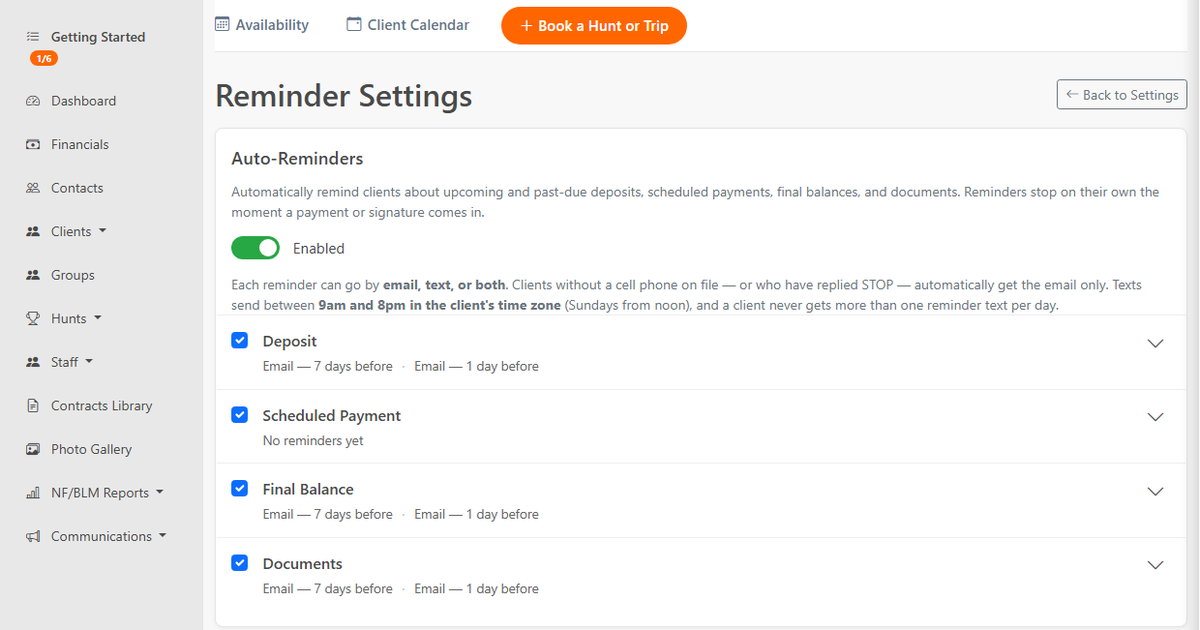
- Automatic reminders do the chasing. They go out by email or text on a schedule you control — before the due date, on it, and after — for deposits, scheduled payments, final balances, and unsigned documents.
- They know when to stop. Reminders end the moment the client pays or signs, and a bank payment that's still clearing pauses them, so a client who already paid is never asked again.
- Processing fees don't have to come out of your price. Card and bank-transfer fees can be added to the client's payment instead.
- Your books keep up. Payments post to the invoice the moment they land, and everything syncs to QuickBooks.
A deposit policy worth copying
If you're starting from scratch, this shape covers most operations:
- 50% deposit due at booking; dates are not held without it.
- Balance due 60 days before the trip.
- Deposits are non-refundable, but transfer once to a future season if the spot re-sells.
- Card and bank-transfer processing fees are added to online payments.
- All terms appear in the signed contract and on the invoice.
Set the numbers to fit your hunts — then let the system do the reminding. See how payments and deposits work in HuntDocs, or read the step-by-step help for setting up automatic reminders.